
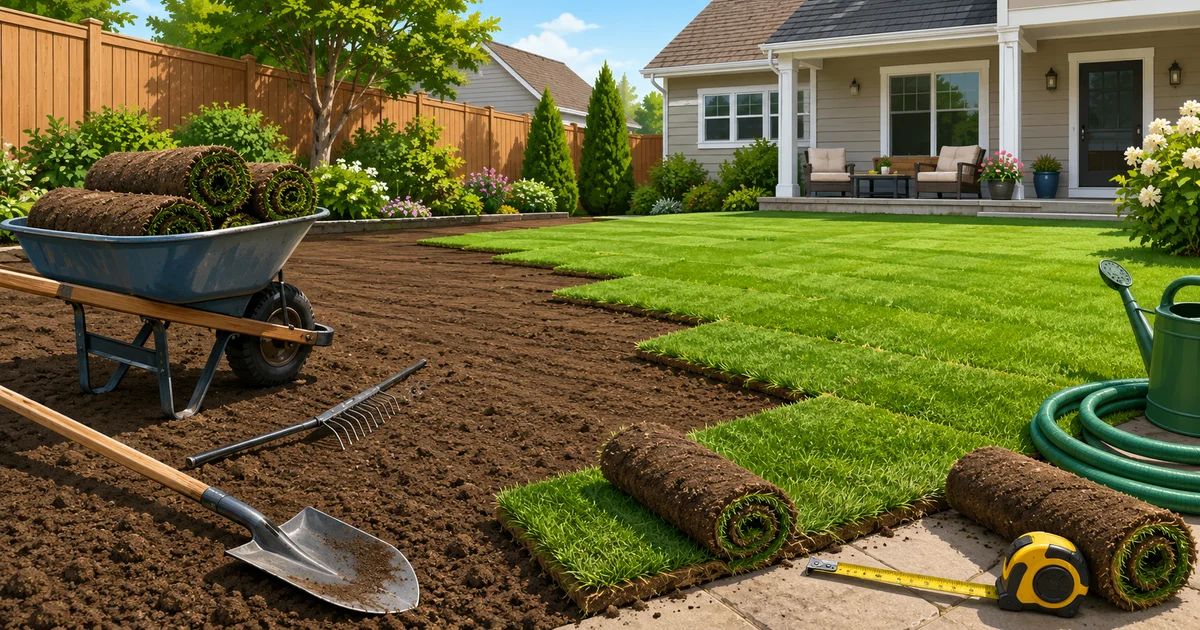
How to Install Sod
Step-by-step guide to installing sod from soil preparation through installation, watering, and ongoing care for a healthy new lawn.
Quick Summary
- Sod must be installed within 24-48 hours of harvest - schedule delivery for the morning of installation day.
- Standard sod pieces are 2 ft x 16 inches (2.67 sq ft each). A pallet covers approximately 450 sq ft (170 pieces).
- Prepare soil 3-4 weeks before sod arrives: grade, amend with compost, and water the bed 24 hours before installation.
- Water deeply within 30 minutes of laying each section - the sod needs 1 inch of water in the first 24 hours.
- Keep foot traffic off new sod for 2-3 weeks while roots establish. First mowing at 2-3 weeks.
- Use our Sod Calculator to determine the exact number of pieces and pallets needed.
Calculators Used in This Guide
Sod provides an instant lawn — green grass the day it is installed, without the 6-12 month wait for seed to establish. However, sod is a perishable product that requires careful timing: it is harvested, delivered, and installed within a 24-48 hour window. Proper soil preparation and immediate watering are the two most critical factors for success.
This guide covers every step from measuring your lawn area through soil preparation, sod installation, watering schedules, and long-term maintenance. With good planning, a 2,000 sq ft lawn installation takes a weekend for a crew of 3. If you are still planning your full landscape layout, see our Backyard Landscaping Planning Guide for zoning, phasing, and overall design strategy.
Step-by-Step Guide
Step 1: Measure the Lawn Area
Measure your lawn area in square feet. For rectangular lawns, multiply length by width. For irregular shapes, divide the yard into rectangles, triangles, and circles, then add the totals. Subtract areas for planting beds, trees, paths, patios, and structures. Use Square Footage Calculator to help with odd shapes. Add 5% waste for rectangular lawns or 10% for irregular lawns with curves and obstacles.
Step 2: Choose Sod Type
Sod choices vary by climate and sun exposure. Common warm-season grasses (Southern US): Bermuda (full sun, drought-tolerant), St. Augustine (shade-tolerant, requires more water), Zoysia (medium sun, dense, soft). Common cool-season grasses (Northern US): Kentucky Bluegrass (full sun, rich color), Tall Fescue (heat/drought tolerant, sun or partial shade), Perennial Ryegrass (fast establishment, mix with bluegrass).
Ask your local sod supplier which variety performs best in your area. Most sod farms grow regional blends. Your county extension office ($10-$25 per soil test) can recommend specific varieties based on your soil type and sun exposure.
Step 3: Order Sod
Use Sod Calculator to determine the exact number of pieces and pallets. Standard sod pieces are 2 ft x 16 inches (2.67 sq ft each). A full pallet covers roughly 450 sq ft (170 pieces) and weighs 2,000-3,000 lbs. Schedule delivery for early morning on the day you plan to install — sod cannot sit on a pallet for more than 24 hours without significant quality loss.
Step 4: Prepare the Soil (3-4 Weeks Before Installation)
Kill existing vegetation with a non-selective herbicide or remove it mechanically by tilling or sod-cutting. Wait 2-3 weeks after herbicide application before tilling. Till the soil 4-6 inches deep and remove rocks, roots, and debris larger than 1 inch in diameter. Add 1-2 inches of organic compost and incorporate it into the top 4 inches of soil. Use Topsoil Calculator to calculate how much compost or topsoil you need.
Grade the soil to slope away from the house at 1/4 inch per foot for positive drainage. Fill any low spots and compact high spots. After grading, rake the surface smooth and lightly compact with a lawn roller half-filled with water. The finished grade should be 1 inch below sidewalks and driveways to account for the sod thickness.
Step 5: Water the Soil (Day Before Installation)
The day before sod arrives, water the prepared soil to a depth of 4-6 inches. The soil should be moist but not muddy — you want it to feel like a wrung-out sponge. If the soil is too dry, the sod roots will not make contact. If too wet, the sod will sit in mud and rot. This pre-moistening step is critical and often overlooked.
Step 6: Lay the Sod
Start along a straight edge — driveway, sidewalk, patio, or a taut string line. Lay sod pieces in staggered rows like brickwork, offsetting the seams between rows by half a piece. Butt pieces tightly together without overlapping or leaving gaps. Use a sharp utility knife or a sod knife to cut pieces around obstacles like sprinkler heads, trees, and beds. Do not walk on freshly laid sod — lay plywood boards to distribute weight if you need to cross installed areas.
Work in a consistent direction across the lawn, laying full pieces first and filling in edges with cut pieces. If you run out of daylight, cover uninstalled sod with a damp tarp to keep it from drying out overnight.
Step 7: Roll and Water Immediately
After each section is laid, roll it with a lawn roller one-quarter to one-half filled with water to ensure firm soil contact — this eliminates air pockets that prevent root growth. Water deeply within 30 minutes of laying each section. The sod needs 1 inch of water in the first 24 hours. In hot weather (85+ degrees F), start watering immediately after each 200-300 sq ft section to prevent the sod from drying out before the section is complete.
Step 8: Follow a Watering Schedule
Week 1: Water daily (2-3 times if hot and dry) to keep sod consistently moist. Sod edges curling up is a sign of drying out. Week 2: Water every other day with deeper soaking (30-45 minutes per zone) to encourage roots to grow downward. Week 3: Water 2-3 times per week; roots are beginning to establish. Week 4 and beyond: Transition to 1-2 times per week with 1 inch per watering. Adjust for natural rainfall. Use a rain gauge or a tuna can on the lawn to measure water depth accurately.
Step 9: First Mowing
Wait 2-3 weeks until the sod is firmly rooted — test by gently lifting a corner of a piece; if it resists lifting, roots have established. Mow at the highest setting on your mower and never cut more than 1/3 of the grass blade length in a single mowing. Use a sharp blade to avoid tearing the new grass. Bag the first few clippings to prevent debris from smothering the new lawn. After 4-6 weeks, you can resume a normal mowing schedule at your preferred height.
Step 10: Fertilize and Maintain
After the sod has rooted (3-4 weeks), apply a starter fertilizer formulated for new lawns. Follow the manufacturer's application rate — more is not better. Water after fertilizing. Avoid heavy foot traffic for the first 3 weeks. After 6-8 weeks, the lawn can handle normal family activity. Apply a pre-emergent weed preventer in early spring and fall to keep weeds from establishing. For ongoing maintenance, mulch around beds and trees using Mulch Calculator to estimate coverage.
Worked Examples
1,200 sq ft Lawn Sod Installation
A 1,200 sq ft rectangular lawn (30 ft x 40 ft) with Kentucky Bluegrass sod on moderately sloped suburban lot.
- →Measure area: 30 x 40 = 1,200 sq ft.
- →Sod pieces: 1,200 / 2.67 = 449 pieces. Add 8% waste for moderate curves around beds: 485 pieces.
- →Pallets: 485 / 170 = 2.85 pallets. Order 3 pallets.
- →Soil prep area: 1,200 sq ft. Till 4-6 in deep, remove debris.
- →Compost needed: 1,200 sq ft x 2 in depth / 324 = 7.4 cu yd. Order 8 cu yd.
- →Topsoil for grading low spots: 1-2 cu yd extra if needed.
- →Installation team: 3 people. Time: 4-6 hours for laying, 1 hour rolling and watering.
- →Water schedule: 30 min after laying (1 in total), then daily for 2 weeks.
Result: Materials: 3 pallets sod ($360-$540), 8 cu yd compost ($240-$400), delivery ($50-$100). Total material estimate: $650-$1,040. With tool rental and water: $750-$1,200 total DIY cost. Professional install: $1,800-$2,400.
Have a garden hose with a spray nozzle and a sprinkler ready at each section before you start laying. The biggest mistake new sod installers make is finishing a section and then scrambling to find the hose — by then the edges are already drying. Stage your watering equipment before the first piece goes down.
Reference Table
| Week | Frequency | Water Amount | Best Time | Notes |
|---|---|---|---|---|
| Week 1 | 1-3 times daily | Keep moist (15-20 min per zone) | Early morning, midday | Sod must stay moist to prevent edge curling |
| Week 2 | Every other day | Deep soak (30-45 min per zone) | Morning | Roots begin establishing; reduce frequency |
| Week 3 | 2-3 times per week | 1 inch per week total | Morning | Encourage deep root growth |
| Week 4+ | 1-2 times per week | 1 inch per week total | Morning | Established lawn schedule; adjust for rain |
Reference Table
| Timing | Task | Tools Needed | Key Detail |
|---|---|---|---|
| 4 weeks before | Kill existing vegetation | Herbicide sprayer or sod cutter | Non-selective herbicide; wait 2-3 weeks to see results |
| 3 weeks before | Test soil pH and nutrients | Soil test kit or county extension | Target pH 6.0-7.0; add lime if below 6.0 |
| 2 weeks before | Till and remove debris | Tiller, rake, wheelbarrow | Till 4-6 in deep; remove rocks over 1 in |
| 1 week before | Add compost and amend | Shovel, rake, spreader | Incorporate 1-2 in compost into top 4 in |
| 2 days before | Final grading and rolling | Lawn roller, rake, string line | Grade 1/4 in/ft slope away from house |
| 1 day before | Water soil to 4-6 in depth | Sprinkler or hose | Soil should be moist like a wrung-out sponge |
| Installation day | Lay sod immediately upon delivery | Sod knife, utility knife, boards | Start straight edge, stagger seams, water within 30 min |
Common Mistakes to Avoid
Not preparing soil before sod arrives
Prepare soil at least 3-4 weeks before. Sod cannot be stored — it must go directly onto prepared ground.
Laying sod on dry soil
Water the soil to 4-6 inches deep the day before installation. Dry soil wicks moisture from the sod, killing the roots.
Overlapping or leaving gaps between pieces
Butt pieces tightly without overlapping. Gaps dry out and weeds fill in. Overlaps create bumps that show in the mowed lawn.
Underwatering in the first week
Sod must stay constantly moist for the first week. In hot weather, water 2-3 times daily. Brown edges indicate the sod is drying out.
Mowing too early or too short
Wait 2-3 weeks for roots to establish. Mow at the highest setting. Cutting too short stresses the new grass and can kill patches.
Skipping the soil test
A $15-$30 soil test tells you your pH and nutrient levels. Adding lime or sulfur before planting is easy; correcting poor pH after sod is installed is nearly impossible without killing the lawn.
DIY Planning Checklist
- Measure lawn area using our Square Footage Calculator.
- Choose sod type based on your climate and sun exposure.
- Order sod using our Sod Calculator — schedule morning delivery.
- Test soil pH; amend with lime or sulfur if needed.
- Kill existing vegetation 3-4 weeks before installation.
- Till soil 4-6 inches deep and remove debris.
- Add compost and amend soil based on soil test results.
- Grade soil to slope away from house at 1/4 in per ft.
- Rake smooth and lightly compact with lawn roller.
- Water soil to 4-6 inches deep the day before installation.
- Set up hoses and sprinklers before first sod piece is laid.
- Lay sod in staggered rows on delivery day.
- Roll sod with water-filled roller for soil contact.
- Water deeply within 30 minutes of laying each section.
- Keep sod consistently moist for first 2 weeks.
- First mowing at 2-3 weeks, highest setting, sharp blade.
- Apply starter fertilizer after rooting (3-4 weeks).
When to Contact a Professional
Sod installation is a straightforward DIY project for most homeowners. Hire a professional for:
- Large properties over 10,000 sq ft requiring multiple pallets and heavy lifting.
- Sloped sites requiring complex grading, retaining walls, or erosion control measures.
- Properties needing extensive soil amendment, regrading, or drainage correction before installation.
- Commercial applications where speed and uniform appearance are critical.
- Anyone with physical limitations — sod pallets weigh 2,000+ lbs and laying sod is physically demanding.
Professional sod installation costs $0.50-$1 per sq ft for labor plus $0.30-$0.90 per sq ft for materials. Total installed: $1-$2 per sq ft. A full-service landscape company handles soil prep, grading, installation, and the first 4 weeks of watering.
Frequently Asked Questions
Related Calculators
Sod Calculator
Calculate how many sod pallets or pieces you need for your lawn.
Square Footage Calculator
Calculate the square footage of any room or space in seconds.
Topsoil Calculator
Calculate cubic yards of topsoil for gardens and lawn establishment.
Mulch Calculator
Calculate bags or cubic yards of mulch for garden beds.
Landscaping Cost Calculator
Estimate landscaping project cost by scope and yard size.
References and Data Sources
TPI - Turfgrass Producers International Installation Standards
Industry standard for sod installation including soil preparation, irrigation requirements, and establishment care. All timing and watering recommendations follow TPI guidelines.
USDA NRCS - Lawn and Turf Installation Guide
Soil preparation standards for turf installation including grading, amendment incorporation, and compaction management. Soil preparation guidelines reference NRCS conservation practice standards.
All references are used for general estimation guidance only. BuildCalcHub does not claim certification, endorsement, or partnership with any listed organization. Always consult a licensed professional for your specific project requirements.
DIY Guides
Explore more step-by-step guides