
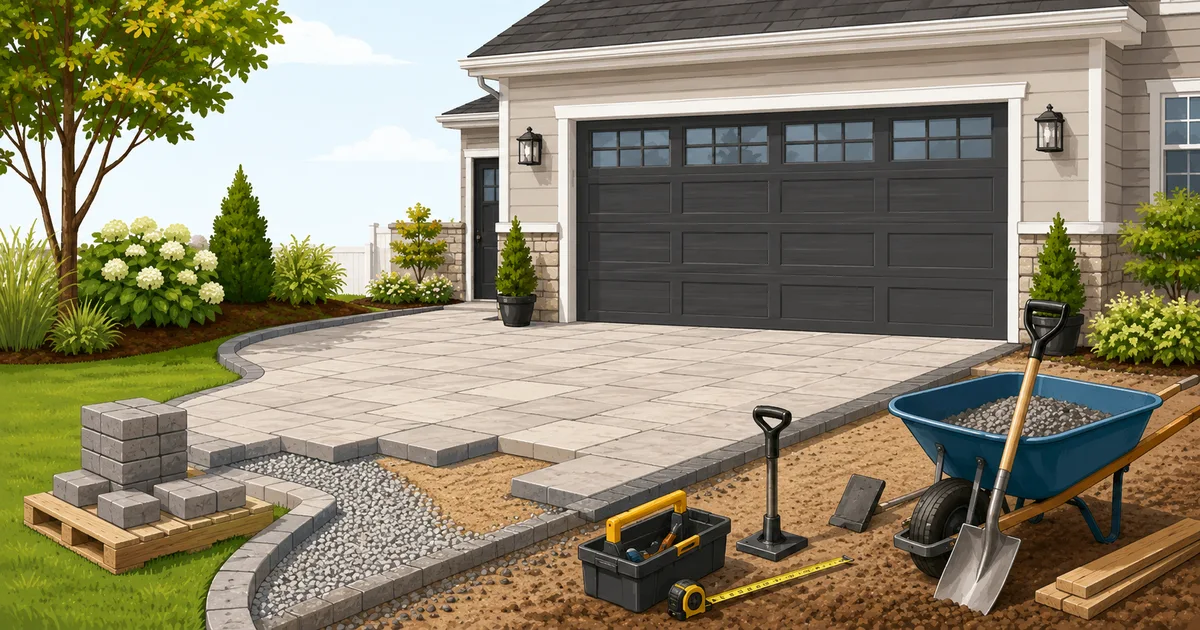
Paver Driveway Cost in 2026: Materials, Labor, Base Prep and Budget Guide
A detailed cost planning guide for paver driveways covering paver types, base preparation requirements, driveway load specifications, edging, drainage, and labor estimates.
Quick Answer
A paver driveway typically costs $12–$30 per square foot installed, or $5,000–$20,000 for a standard two-car driveway (400–600 sq ft). Material choice is the biggest cost driver: concrete pavers run $3–$6 per sq ft for materials alone, while clay brick and natural stone can reach $8–$15 per sq ft. Base preparation, edging, and sealing add $3–$8 per sq ft. A DIY paver driveway can reduce total cost by 30–50% but requires significant labor for excavation and compaction.
Quick Estimate
The table below shows broad 2026 US planning ranges for a standard 500 sq ft two-car paver driveway. Actual costs vary by region, site access, soil conditions, and material availability.
| Cost Component | Low Range | Mid Range | High Range |
|---|---|---|---|
| Concrete pavers (materials) | $1,500 | $2,500 | $4,000 |
| Excavation and base prep | $500 | $1,000 | $2,000 |
| Base aggregate (gravel, sand) | $400 | $700 | $1,200 |
| Edging and restraints | $200 | $400 | $700 |
| Paver sand and joint filler | $200 | $350 | $500 |
| Sealing | $150 | $300 | $500 |
| Labor (professional install) | $2,500 | $5,000 | $8,000 |
| Total professional install | $5,500 | $10,250 | $16,900 |
| Total DIY (materials only) | $2,950 | $5,250 | $8,900 |
Ranges are broad 2026 US planning estimates. Verify material and labor pricing with local suppliers and contractors.
Planning estimate: All cost figures shown are broad 2026 US averages for planning purposes only. Material and labor costs vary significantly by region, site access, market conditions, and project specifications. Verify prices with local suppliers and contractors. This is not a quote, guarantee, or professional estimate.
Calculators Used in This Guide
Paver Types and Material Costs
The paver material you choose directly affects your total driveway cost. Concrete pavers are the most common choice because they balance durability with affordability. Clay brick pavers offer a classic look but cost more and are less resistant to freeze-thaw cycles in northern climates. Natural stone pavers such as travertine, flagstone, or bluestone provide a high-end appearance at a premium price.
| Paver Type | Material Cost per Sq Ft | Durability | Best For |
|---|---|---|---|
| Concrete pavers | $3–$6 | High | Most driveways, moderate to heavy loads |
| Clay brick pavers | $5–$10 | Moderate | Warm climates, traditional look |
| Travertine / natural stone | $8–$15 | High | Premium projects, low-traffic areas |
| Permeable pavers | $5–$10 | High | Eco-friendly, drainage-sensitive sites |
| Large-format concrete | $6–$12 | Very high | Modern designs, heavy vehicle traffic |
Concrete pavers are available in a wide range of colors, shapes, and patterns. Interlocking pavers add structural strength by distributing vehicle weight across adjacent units. For driveway use, choose pavers with a minimum thickness of 60 mm (2.4 inches). Thinner pavers rated for patios may crack under vehicle loads.
Driveway Base Preparation: The Most Critical Layer
A paver driveway requires a much deeper base than a paver patio because it must support vehicle weight without settling. The standard driveway base consists of three layers: sub-base, base, and bedding sand. Total base depth for a driveway should be 10–12 inches, compared to 6–8 inches for a patio.
Excavation removes existing soil to the required depth plus paver thickness. This is the most labor-intensive part of a DIY paver driveway. Renting a mini-excavator can speed up the work but adds $200–$400 per day to your equipment budget. Disposal of excavated material may also incur hauling fees.
The sub-base layer uses 3–4 inches of large crushed stone (road base or #57 stone). The base layer adds 4–6 inches of compactible gravel (ABC or crusher run). Each layer must be compacted with a plate compactor in 2–3 inch lifts. Skipping proper compaction is the most common cause of paver driveway failure.
A 2-inch bedding sand layer goes on top of the compacted gravel. The sand must be screeded level before laying pavers. Do not use the sand layer to correct grading errors — the base must already be at the correct slope before sand goes down.
Driveway Slope and Drainage Requirements
Driveways need a minimum slope of 1–2% (1/8 to 1/4 inch per foot) for proper surface drainage. Water that pools on a paver driveway can weaken the base, promote weed growth between joints, and cause heaving in freeze-thaw climates. The slope should run away from the garage or house foundation.
In areas with heavy rain or snowmelt, consider installing a trench drain or channel drain across the driveway apron to capture runoff before it reaches the street. French drains along the driveway edges can also manage subsurface water that might saturate the base.
Permeable paver systems are designed to allow water to pass through the joints into a deeper stone reservoir. These systems are required in some municipalities with stormwater management regulations. Permeable pavers cost more upfront but can eliminate the need for separate drainage infrastructure.
Edge Restraints: Keeping Pavers in Place
Edge restraints are non-negotiable for a paver driveway. Without them, the outer pavers will shift laterally under vehicle weight, causing the entire surface to spread and settle unevenly. Concrete curbing is the most durable edge restraint for driveways, typically costing $8–$15 per linear foot installed. Plastic or aluminum edge restraints are a lower-cost alternative at $2–$5 per linear foot but require staking into a concrete footing for driveway applications.
The edge restraint should extend below the paver surface and be set in a concrete haunch. The driveway approach where it meets the street or garage apron is especially vulnerable to edge movement and needs the strongest restraint available.
Paver Patterns for Driveways
The paver pattern affects both appearance and structural performance. Herringbone patterns (45 or 90 degrees) offer the best load distribution for driveways because the interlocking geometry resists lateral forces in multiple directions. Running bond and basketweave patterns are visually appealing but provide less structural support for heavy vehicle loads.
For straight-line patterns, use a soldier course (border row of pavers laid perpendicular to the main pattern) along the driveway edges and at the street apron. This reinforces the perimeter where stress is highest.
Joint Sand and Sealing
After pavers are installed, polymeric sand is swept into the joints and activated with water. Polymeric sand hardens when wet, creating a flexible joint that resists weed growth, insect infiltration, and washout. For driveways, use polymeric sand rated for vehicular traffic. Standard joint sand will wash out over time under the pressure of water runoff and tire spray.
Sealing a paver driveway is optional but recommended. A quality sealer protects paver color from UV fade, reduces stain penetration from oil and grease, and makes future cleaning easier. Sealer costs $0.50–$1.50 per sq ft for materials and should be reapplied every 2–4 years depending on climate and wear. Some sealers also enhance the natural color of the pavers, giving the driveway a wet-look finish.
Worked Example: 500 sq ft Concrete Paver Driveway
This line-item breakdown shows a standard two-car driveway using 60 mm concrete pavers with a herringbone pattern. Prices are 2026 US planning averages. Your actual costs depend on region, site access, and soil conditions.
| Item | Quantity | Unit Cost | Total |
|---|---|---|---|
| Concrete pavers (60 mm, herringbone pattern) | 2,000 pavers | $0.80/paver | $1,600 |
| Crushed stone sub-base (4 inches, #57 stone) | 6.5 cu yds | $35/cu yd | $228 |
| Compacted gravel base (6 inches, ABC stone) | 9.5 cu yds | $30/cu yd | $285 |
| Bedding sand (2 inches) | 3 cu yds | $35/cu yd | $105 |
| Concrete edge restraint (curbing) | 90 linear ft | $10/ft | $900 |
| Polymeric sand (vehicular grade) | 10 bags | $25/bag | $250 |
| Sealer (first application) | 500 sq ft | $0.80/sq ft | $400 |
| Total materials (DIY) | $3,768 | ||
This $3,768 estimate covers materials for a 500 sq ft driveway with concrete pavers, full base depth, concrete edge restraint, and initial sealer. Adding professional labor at $5,000–$8,000 brings the installed total to $8,768–$11,768, or about $17.50–$23.50 per sq ft. Using clay brick pavers instead of concrete would add roughly $2,000–$4,000 to the material cost. Opting for plastic edge restraints instead of concrete curbing saves about $600.
Use the Paver Calculator to estimate paver count for your driveway dimensions. The Gravel Calculator handles base aggregate volume, and the Sand Calculator covers bedding sand needs.
Maintenance and Repair Over Time
A paver driveway requires periodic maintenance but is generally easier to repair than asphalt or concrete. The primary maintenance tasks are sweeping and reapplying polymeric joint sand every 2–4 years ($200–$500 for a 500 sq ft driveway) and reapplying sealer every 2–4 years ($400–$750 per application). Snow plowing on paver driveways requires care — set the plow blade 1 inch above the paver surface to avoid catching paver edges. Use plastic blades rather than steel if plowing frequently.
Vehicle fluid leaks are the most common stain issue. Oil, transmission fluid, and coolant penetrate paver surfaces if not cleaned immediately. A quality sealer reduces stain penetration and makes cleaning easier. For stains that have already set, paver-specific cleaners are available at hardscape suppliers for $15–$30 per gallon.
Individual pavers that crack from heavy loads or freeze-thaw cycles can be replaced one at a time: lift the damaged paver, remove and replace the sand below, set a new paver, and sweep new joint sand into the gaps. This targeted repair costs $5–$15 per paver in materials, compared to $500–$2,000 for patching a concrete driveway crack or $3,000–$8,000 for repaving an asphalt driveway section.
Snow, Ice, and Freeze-Thaw Considerations
Paver driveways in cold climates require some specific considerations. De-icing salts (sodium chloride, calcium chloride, and magnesium chloride) are generally safe for concrete pavers, but avoid using ammonium sulfate or ammonium nitrate deicers — these chemically attack the paver surface and cause scaling within 2–3 seasons. Sand provides traction without damaging pavers and is the safest choice for paver driveways in freezing conditions.
Freeze-thaw cycles are less damaging to pavers than to monolithic concrete because the joints absorb expansion. However, if water penetrates the base and freezes, it can cause heaving. Proper base drainage — including a 4-inch layer of washed #57 stone at the sub-base level — allows water to drain below the frost line rather than freezing under the pavers. In areas with deep frost (over 36 inches), increase the base depth to 12–14 inches for additional protection.
DIY vs Professional Installation
A DIY paver driveway is a significant undertaking. Excavating 10–12 inches of base depth over 500 sq ft means moving roughly 15–18 cubic yards of soil and gravel — about 20–25 tons of material. Renting equipment (mini-excavator, plate compactor, concrete saw) adds $500–$1,000 to the project cost.
Professional installation typically doubles the total project cost but includes excavation, grading, compaction, drainage, edge restraints, and a warranty on workmanship. For driveways longer than 60 feet or with complex curves, professional grading equipment and experience often produce a more reliable result.
If you choose to DIY, invest in a good plate compactor with at least 5,000 lbs of compaction force. Rent a jumping jack compactor for the deeper base lifts. Take the time to compact every layer thoroughly — this is not a step you can rush.
Common Paver Driveway Mistakes to Avoid
Insufficient base depth. A 4-inch base that works for a patio will fail under a truck. Driveways need 10–12 inches of compacted base. Skimping here leads to settling within the first year.
Poor drainage slope. Water must run off the surface. Flat areas or negative slopes toward the house cause pooling and base erosion. Verify slope with a string line and level before laying pavers.
Wrong paver thickness. Patio pavers (40–50 mm) crack under vehicle weight. Driveway pavers must be 60 mm or thicker. Check the manufacturer rating before purchasing.
Skipping the plate compactor on pavers. After pavers are laid and sand is swept, run the plate compactor over the surface (with a rubber pad or paver protector) to settle pavers into the sand bed evenly.
Installing without edge restraints. Edge restraints prevent lateral movement. Without them, the outer pavers shift, joints open, and the surface degrades quickly. Always install concrete or heavy-duty edge restraints on driveways.
When to Use a Calculator for Your Paver Driveway
Before buying materials, use the Paver Calculator to estimate the number of pavers needed based on your driveway dimensions and paver size. The Square Footage Calculator helps confirm your driveway area. Use the Gravel Calculator to estimate base aggregate volume, and the Sand Calculator for bedding sand quantities. These tools give you a material list to bring to your local supplier for accurate pricing. For a broader project estimate, the existing patio and driveway cost guide covers general budget considerations.
Building Codes and Regulations
Many municipalities require driveway permits for new installations or replacements. Common requirements include minimum setback distances from property lines, maximum slope angles, and apron thickness standards at the street connection. Some areas restrict impervious surface coverage or require permeable paving solutions. Check with your local building department before starting. Homeowners associations may also have rules about paver color, pattern, or material.
For drainage and grading changes that affect neighboring properties, consult a civil engineer or landscape architect, especially if your driveway requires retaining walls, significant regrading, or stormwater management features.
Frequently Asked Questions
Related Calculators
References and Data Sources
Interlocking Concrete Pavement Institute (ICPI) — Residential Driveway Guidelines
Industry standards for paver driveway base depth, paver thickness, edge restraints, and installation best practices for residential applications.
National Association of Home Builders — 2026 Cost of Doing Business Study
Labor cost benchmarks and material pricing trends for US residential hardscape and driveway construction.
American Society of Civil Engineers — Permeable Pavement Design
Technical guidance on permeable paver systems for stormwater management and driveway applications.
All references are used for general estimation guidance only. BuildCalcHub does not claim certification, endorsement, or partnership with any listed organization. Always consult a licensed professional for your specific project requirements.
Cost Guides
Explore more project cost guides