
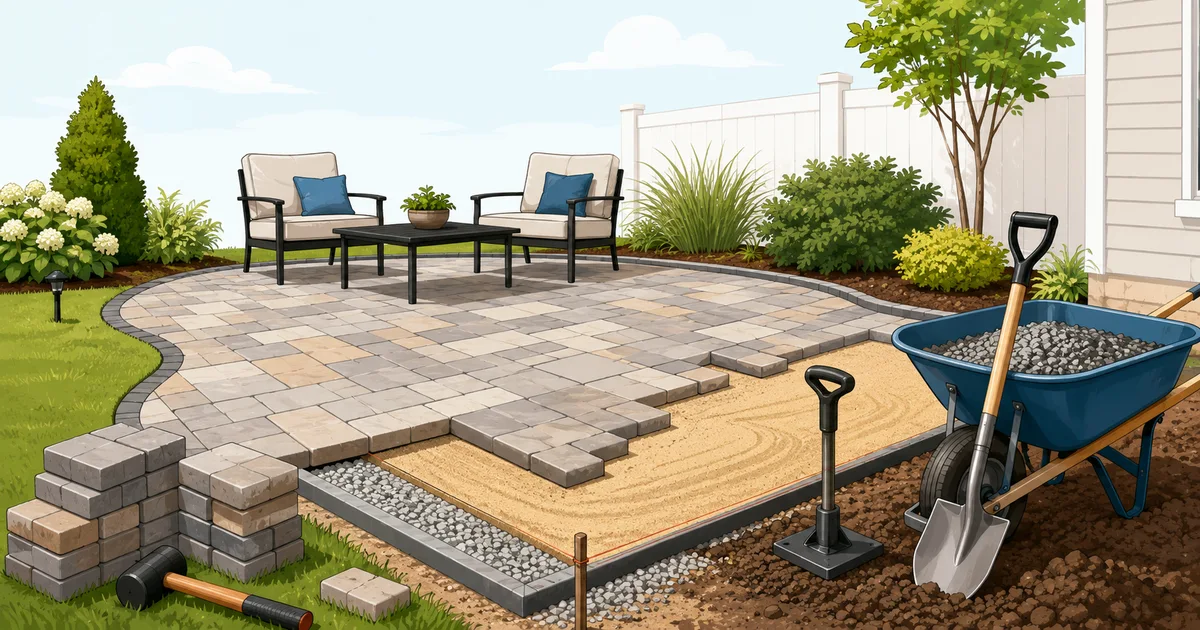
How to Plan and Install a Paver Patio
A complete guide to planning and installing a paver patio including base preparation, paver selection, pattern options, edging, and cost considerations.
Quick Summary
- A paver patio requires 4-6 inches of compacted gravel base plus 1 inch of bedding sand for proper support.
- Standard 4x8 inch concrete pavers cover 0.22 sq ft each - a 12x16 ft patio needs approximately 960 pavers with 10% waste.
- Running bond is the easiest pattern for beginners; herringbone is strongest for heavy use.
- Polymeric sand joints prevent weed growth and lock pavers in place - standard sand washes out within 1-2 years.
- Edge restraints are required on all sides to prevent pavers from shifting outward over time.
- Use our Paver Calculator to determine exact quantities before ordering materials.
Calculators Used in This Guide
A paver patio transforms a bare yard into a functional outdoor living space. Unlike poured concrete, pavers offer design flexibility, easy repairs, and natural drainage through joint sand. This guide covers the full process from planning and material selection through base preparation, installation, and finishing.
Whether you are installing a small 10x10 ft patio or a large 20x20 ft entertainment area, the process is the same. The key to a successful paver patio is proper base preparation — 70% of the work is below the surface. Rushing the base leads to settling, uneven pavers, and frustrated homeowners within the first year.
This guide covers what you need to plan, measure, order, and install a paver patio yourself. It focuses on the installation sequence, material quantities, and how to use BuildCalcHub calculators at each step. For detailed cost comparisons between paver and concrete patios, see our Patio and Driveway Cost Guide.
Step-by-Step Guide
Step 1: Plan and Measure
Decide on the patio location, size, and shape. Mark the area with spray paint or string lines. Measure the length and width in feet. For irregular shapes, divide into rectangles and calculate each separately. Check underground utilities before digging — call 811 for a free utility locate (required by law in most states).
Use Square Footage Calculator to confirm your total patio area. Note the direction of natural drainage on your property and plan the patio slope (1/4 inch per foot away from structures). This is also the time to check with your local building department about permit requirements and HOA rules.
Step 2: Choose Pavers and Pattern
Common paver sizes: 4x8 in (brick-style), 6x6 in (square), 6x9 in (rectangular), and 12x12 in (large format). Thickness varies by use: 60 mm for patios and walkways, 80 mm for driveways with occasional traffic. Your paver choice affects the overall look, installation difficulty, and long-term durability.
Pattern options: running bond is the easiest for beginners and requires about 10% waste. Herringbone is the strongest and best for driveways but requires more cuts (15% waste). Basket weave offers a classic decorative look (15% waste). Stack bond is modern and clean with the least waste (5-8%) but less structural interlock. Use Paver Calculator to get exact counts for your chosen paver size and pattern.
Step 3: Order Materials
Based on your patio dimensions and chosen materials, order:
- Pavers: total quantity from the Paver Calculator plus pattern waste.
- Base gravel: 3/4-inch minus crushed stone, calculated as cubic yards (area x base depth / 27). Use Gravel Calculator for tonnage.
- Bedding sand: concrete sand, roughly 1 ton per 100 sq ft of patio for 1-inch depth. Use Sand Calculator.
- Edge restraints: steel or plastic paver edging equal to the patio perimeter plus 10% for overlap and cuts.
- Polymeric sand: one 50 lb bag covers approximately 75-100 sq ft of paver joints.
Schedule material delivery in phases — base materials first, then pavers the day before you are ready to lay them. Staging reduces crowding and lets you work through the base at your own pace.
Step 4: Excavate
Excavate to the total depth shown in the base depth table below. For a standard patio, dig 7-8 inches deep (4-6 in gravel + 1 in sand + 2.3 in paver thickness). Slope the excavation away from the house at 1/4 inch per foot for positive drainage. Remove all sod, roots, and organic material — any organic matter left under the base will decompose and cause settling. Use a plate compactor on the native soil at the bottom of the excavation before adding gravel (this step is often skipped but prevents long-term settling).
Step 5: Install and Compact the Gravel Base
Spread crushed stone (typically 3/4-inch minus gravel) in 2-inch lifts. Compact each lift with a plate compactor before adding the next, making 3-4 overlapping passes per section. The base should reach 98% standard Proctor density. Check the level with a 6-ft level or a transit frequently — an uneven base creates an uneven patio that cannot be corrected by adjusting the sand layer later. When you reach finished base height, the surface should be smooth, firm, and sloping correctly toward the drainage direction. Use Gravel Calculator to verify you ordered enough material before you start.
Step 6: Install Edge Restraints
Install steel or plastic paver edging along all sides of the excavated area before laying pavers. Secure edging with 10-12 inch galvanized spikes every 2-3 feet. Edge restraints prevent the pavers from spreading outward under foot traffic and freeze-thaw cycles. For curved edges, use flexible plastic edging designed for curves. At the house wall, the restraint also prevents water from seeping toward the foundation.
Step 7: Add Bedding Sand
Spread 1 inch of concrete sand over the compacted gravel base. Use 1-inch diameter PVC pipes laid across the base as screed guides, spaced 4-6 ft apart. Pull a straight 2x4 board across the pipes to level the sand. Do not wet or compact the sand layer — it should stay loose so the pavers settle into it evenly as you compact the finished surface. Only lay as much sand as you can cover with pavers in a single session to avoid wind or rain disturbing the level surface.
Step 8: Lay the Pavers
Start at the straightest edge (house wall, walkway, or a taught string line). Place pavers in your chosen pattern butted tightly together with no gaps. Use a rubber mallet to tap each paver into the sand bed. Check level every few rows with a 4-ft level stretched across multiple pavers. For cuts at edges, use a wet saw with a diamond blade or a paver splitter tool. Save all cut pieces — you may be able to use them at the opposite edge. Wear eye and ear protection when cutting, and do all cutting away from the installed area to keep dust off the sand bed.
Step 9: Compact and Add Joint Sand
After all pavers are laid, compact the entire surface with a plate compactor fitted with a rubber mat to prevent chipping paver edges. Make two passes in different directions. Sweep polymeric sand into all joints, filling them completely. Use a push broom to work the sand deep into the gaps, sweeping diagonally across the joints. Activate the polymeric sand with a fine water mist according to the manufacturer instructions — typically a light mist until the sand is damp but not pooled. Allow 24-48 hours to cure before foot traffic and 72 hours before heavy furniture or vehicles.
Step 10: Seal and Maintain (Optional but Recommended)
Apply a penetrating paver sealer after the joint sand has fully cured (2-4 weeks). Sealer protects paver color from fading, locks joint sand in place, and suppresses weed germination. Cost runs $0.50-$1.50 per sq ft for professional application. Reapply every 3-5 years depending on sun exposure and winter salt usage. Wet-look sealers add depth to paver colors but can be slippery when wet — use a matte or satin finish for patios with pool access. For ongoing maintenance, sweep regularly with a stiff broom, rinse with a garden hose, and spot-clean spills quickly. Avoid power washing on high pressure as it can dislodge joint sand.
Worked Examples
12x16 ft Paver Patio Material Calculation
A 12x16 ft (192 sq ft) rectangular patio using 4x8 inch concrete pavers in running bond pattern.
- →Patio area: 12 x 16 = 192 sq ft.
- →Pavers needed (before waste): 192 / 0.22 = 873 pavers.
- →With 10% waste (running bond): 873 x 1.10 = 960 pavers.
- →Gravel base: 192 sq ft x 4 in depth = 192 x 0.33 / 27 = 2.37 cu yd. Order 2.5 cu yd (3 tons).
- →Bedding sand: 192 x 1 in / 12 / 27 = 0.59 cu yd. Order 0.75 cu yd (1.2 tons).
- →Edge restraints: (12+16) x 2 = 56 linear ft. Order 62 ft with overlap.
- →Polymeric sand: 192 / 80 sq ft per bag = 2.4 bags. Order 3 bags.
- →Compactor rental: 2 days at $60/day = $120. Rubber mat for compactor: $25.
Result: Required materials: 960 pavers, 2.5 cu yd gravel, 0.75 cu yd sand, 62 ft edging, 3 bags polymeric sand. Material cost estimate: pavers ($1,200-$2,400), base materials ($300-$600), edging and sand ($100-$200), tool rental ($145). Total DIY: $1,745-$3,345 depending on paver quality.
Order base materials a week before pavers arrive. Base preparation takes 1-2 days and you want the base fully compacted and approved before pavers show up. Pavers are heavy — schedule delivery as close to the work area as possible to minimize manual hauling. A pallet of pavers weighs 2,000-3,000 lbs.
Reference Table
| Application | Gravel Base Depth | Sand Bedding | Total Excavation Depth |
|---|---|---|---|
| Patio (foot traffic) | 4-6 in | 1 in | 7-8 in |
| Walkway | 4 in | 1 in | 6-7 in |
| Driveway (light vehicles) | 8-10 in | 1 in | 11-12 in |
| Driveway (heavy vehicles) | 12 in | 1 in | 15 in |
| Pool deck | 4-6 in | 1 in | 7-8 in |
Reference Table
| Material | Purpose | How to Calculate | Typical Cost (per unit) |
|---|---|---|---|
| Concrete pavers | Patio surface | Area (sq ft) / paver area x (1 + waste %) | $0.50-$2.50 per paver (4x8) |
| Crushed gravel (3/4-in minus) | Base layer support | Area x base depth (ft) / 27 = cubic yards | $30-$60 per ton delivered |
| Concrete sand | Bedding layer | Area x 0.083 (1 in) / 27 = cubic yards | $25-$50 per ton |
| Polymeric sand | Joint filling and locking | 1 bag per 75-100 sq ft of patio | $25-$50 per 50 lb bag |
| Edge restraints | Prevent paver spreading | Perimeter of patio (linear ft) + 10% | $0.50-$2 per linear ft |
| Plate compactor | Compact base and pavers | Rental: 1-2 days | $50-$80 per day |
Reference Table
| Pattern | Waste Factor | Difficulty | Best For | Visual Appeal |
|---|---|---|---|---|
| Running Bond | 10% | Beginner | Patios, walkways | Classic, traditional |
| Herringbone | 15% | Advanced | Driveways | Strong, interlocking |
| Basket Weave | 15% | Intermediate | Decorative patios | Intricate, timeless |
| Stack Bond | 5-8% | Beginner | Modern patios | Clean, contemporary |
Common Mistakes to Avoid
Skipping the gravel base or making it too shallow
Always use at least 4 inches of compacted gravel for patios. The base prevents settling and frost heave.
Not compacting the gravel in lifts
Compact gravel in 2-inch lifts with a plate compactor. Loose gravel settles 10-15% after pavers are installed.
Using regular sand instead of polymeric sand for joints
Polymeric sand hardens when activated with water, creating weed-proof joints. Standard sand washes out within 1-2 years.
Skipping edge restraints
Edge restraints are required on all sides. Without them, pavers shift outward, joints widen, and the patio deteriorates.
Laying pavers on wet or rainy days
Install pavers in dry weather. Wet sand does not compact properly and polymeric sand cannot be activated correctly in rain.
Not sloping the patio away from the house
The finished patio must slope at least 1/4 inch per foot away from the house foundation. Standing water against the house causes basement leaks and foundation damage.
DIY Planning Checklist
- Call 811 for utility locate before digging.
- Verify HOA rules and obtain permits if required.
- Measure the patio area and calculate materials using our Paver Calculator.
- Order all materials: pavers, gravel, sand, edge restraints, polymeric sand.
- Excavate to proper depth with drainage slope away from house.
- Compact gravel base in 2-inch lifts to 98% Proctor density.
- Install edge restraints on all sides.
- Spread and level 1 inch of bedding sand using screed guides.
- Lay pavers in chosen pattern, tight together, checking level.
- Compact pavers with plate compactor (use rubber mat).
- Sweep in polymeric sand and activate with water mist.
- Allow 24-48 hours curing before heavy furniture or traffic.
- Apply sealer after 2-4 weeks (optional but recommended).
When to Contact a Professional
Paver patios are one of the most DIY-friendly hardscape projects for flat, accessible sites. However, hire a professional for:
- Large patios over 400 sq ft that require heavy excavation and multiple days of work.
- Sloped sites requiring significant grading, drainage systems, or retaining walls.
- Complex patterns like herringbone or circular designs that require advanced cutting.
- Driveway paver installations requiring deep base preparation and heavy vehicle load ratings.
- Any project where soil conditions are poor (clay, high water table, or unstable ground).
Professional installation costs $10-$20 per sq ft installed and includes a warranty. DIY saves 40-60% on labor but requires $200-$400 in tool rental and 2-4 weekends of labor.
Frequently Asked Questions
Related Calculators
Paver Calculator
Calculate pavers needed and total cost for patios and driveways.
Patio Cost Calculator
Estimate patio installation cost by material and size.
Gravel Calculator
Calculate cubic yards or tons of gravel for driveways and paths.
Sand Calculator
Find how much sand you need for pavers, sandboxes, or leveling.
Square Footage Calculator
Calculate the square footage of any room or space in seconds.
Concrete Calculator
Calculate bags or cubic yards of concrete needed for any project.
References and Data Sources
ICPI - Interlocking Concrete Pavement Institute Installation Guide
Industry standard installation guidelines for concrete paver patios including base preparation, edge restraint requirements, and joint sand specifications.
ASTM C902 - Pedestrian and Light Traffic Paving Brick Standard
Material standard for concrete and clay pavers including strength classification, freeze-thaw durability, and dimensional tolerances for residential paver applications.
All references are used for general estimation guidance only. BuildCalcHub does not claim certification, endorsement, or partnership with any listed organization. Always consult a licensed professional for your specific project requirements.
DIY Guides
Explore more step-by-step guides