
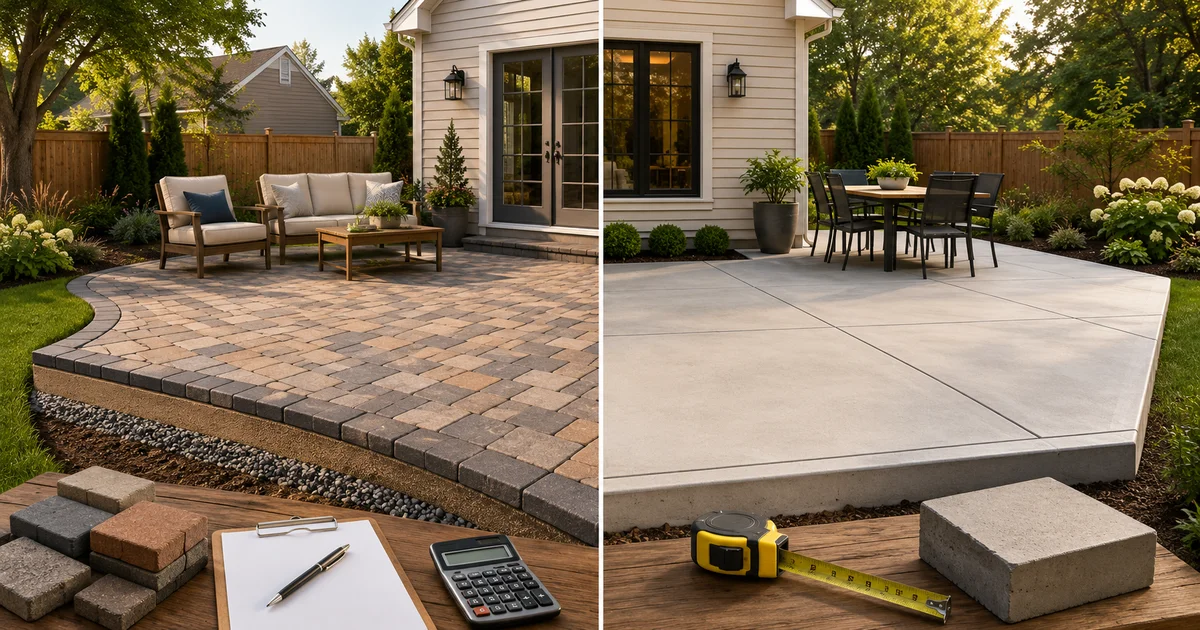
Paver Patio vs Concrete Patio Cost in 2026: Which Option Fits Your Budget?
A head-to-head cost comparison between paver patios and concrete patios covering upfront installation, base preparation, maintenance, repairs, DIY difficulty, design flexibility, and long-term value.
Quick Answer
A concrete patio typically costs $8–$18 per square foot installed, while a paver patio costs $12–$25 per square foot installed. Concrete has a lower upfront cost, but pavers offer easier repairs, better freeze-thaw resistance, and higher resale value. Over a 25-year period, the total cost of ownership (including maintenance and repairs) is comparable: $12–$22 per sq ft for concrete with periodic resealing, vs $14–$28 per sq ft for pavers with joint sand maintenance and occasional paver replacement.
Quick Estimate
Cost comparison for a 300 sq ft patio (typical 15x20 ft). 2026 US planning estimates.
| Cost Factor | Concrete Patio | Paver Patio |
|---|---|---|
| Upfront installed cost (300 sq ft) | $2,400–$5,400 | $3,600–$7,500 |
| Cost per square foot installed | $8–$18 | $12–$25 |
| DIY material cost (300 sq ft) | $900–$1,800 | $1,200–$2,400 |
| Annual maintenance cost | $50–$200 (reseal every 2–4 yrs) | $30–$100 (joint sand, occasional leveling) |
| Typical lifespan | 20–30 years | 25–40 years |
| DIY difficulty | Hard (forms, finishing, curing) | Moderate (base prep, leveling, compaction) |
| Repair difficulty | Hard (cut slab, patch, color match) | Easy (replace individual pavers) |
| Resale value impact | Good (standard expectation) | Excellent (premium aesthetic factor) |
| 25-year total cost of ownership | $12–$22 / sq ft | $14–$28 / sq ft |
Ranges are broad planning estimates. Actual costs depend on region, site conditions, material availability, and design complexity.
Planning estimate: All cost figures shown are broad 2026 US averages for planning purposes only. Material and labor costs vary significantly by region, site access, market conditions, and project specifications. Verify prices with local suppliers and contractors. This is not a quote, guarantee, or professional estimate.
Calculators Used in This Guide
Upfront Cost Comparison
Concrete patios have a clear advantage on upfront cost. A standard 4-inch thick concrete slab with a broom finish, control joints, and minimal reinforcement costs $8–$12 per sq ft installed. Stamped or stained concrete adds $4–$8 per sq ft, bringing the total to $12–$18 per sq ft — comparable to the low end of paver pricing.
Paver patios start at $12 per sq ft for basic concrete pavers and a standard base, increasing to $20–$25 per sq ft for premium pavers, complex patterns, or curved layouts. The higher upfront cost comes from the multi-layer base structure (compacted aggregate, bedding sand, and pavers) and the labor required for precise installation.
For a 300 sq ft patio, the upfront cost difference between concrete and pavers is typically $1,200–$2,100. This gap narrows when you consider concrete upgrades like coloring, stamping, or exposed aggregate finishes that bring the concrete cost closer to paver pricing.
Base Preparation: Similar Requirements, Different Costs
Both concrete and paver patios require proper base preparation, but the specifications differ. A concrete slab needs 4–6 inches of compacted sub-base for a patio, while a paver patio needs 6–8 inches of compacted aggregate plus 1–2 inches of bedding sand. The deeper base for pavers adds $0.50–$1.50 per sq ft in additional excavation and gravel costs.
Concrete requires forms, reinforcement (wire mesh or rebar for larger slabs), and control joints to manage cracking. Paver patios require edge restraints on all sides to prevent lateral movement. Both systems add $0.50–$1 per sq ft in these ancillary costs. Use the Gravel Calculator to estimate base aggregate volume and the Sand Calculator for bedding sand quantities.
Worked Example: 300 sq ft Patio — Pavers vs Concrete
The following side-by-side comparison shows what a 300 sq ft (15 ft x 20 ft) patio costs for each material. This is a common size for a family-sized patio with room for a dining set, grill, and lounge chairs. Prices are 2026 US planning averages and will vary by region and season.
| Item | Concrete Patio | Paver Patio |
|---|---|---|
| Base aggregate (4-inch concrete / 6-inch paver) | $150–$300 | $250–$450 |
| Surface material (poured concrete vs concrete pavers) | $500–$900 | $900–$1,800 |
| Rebar / wire mesh (concrete) or bedding sand (paver) | $80–$150 | $60–$100 |
| Edge restraints / forms | $50–$100 | $150–$300 |
| Polymeric sand / sealer | $60–$120 | $50–$80 |
| Total materials (DIY) | $840–$1,570 | $1,410–$2,730 |
| Professional labor | $1,200–$3,000 | $1,800–$4,200 |
| Total professional install | $2,040–$4,570 | $3,210–$6,930 |
The cost gap between concrete and pavers narrows considerably when concrete upgrades are included. A stamped or colored concrete patio adds $1,200–$2,400 to the concrete total, bringing it to $3,240–$6,970 — essentially the same as the paver range. For homeowners considering decorative concrete finishes, the upfront cost advantage over pavers largely disappears. Use the Square Footage Calculator to confirm your patio area, and the Paver Calculator or Concrete Calculator to estimate material quantities for your specific dimensions.
Design Flexibility
Pavers offer significantly more design flexibility than concrete. Pavers come in dozens of shapes, sizes, colors, and patterns (herringbone, running bond, basketweave, circular). You can create borders, bands, and mixed-material designs within the same patio. Curved paver patios are easier to install than curved concrete (which requires custom bent forms).
Stamped concrete can mimic the look of stone, brick, or slate at a lower cost than natural materials, but the pattern is limited to the stamps available from your contractor. Color options for concrete are also more limited than paver color selections. Once concrete is poured and stamped, changing the design requires demolition and repouring.
Maintenance and Repair Costs Over Time
Concrete patios require resealing every 2–4 years to maintain color and protect against stains, especially for stamped or colored concrete. A full reseal costs $200–$600 for a 300 sq ft patio. Concrete cracks over time as the ground settles — hairline cracks are cosmetic, but larger cracks or slab settling may require mudjacking ($5–$10 per sq ft) or slab replacement ($8–$18 per sq ft). Over 25 years, concrete resealing alone adds $1,500–$4,500 in maintenance costs.
Paver patios require less intensive maintenance. The primary task is topping up polymeric joint sand every 2–4 years, costing $30–$80 per application. If pavers settle unevenly, they can be lifted, the base re-graded, and the pavers reinstalled — a much simpler fix than concrete slab repair. Individual pavers that crack or stain can be replaced for $2–$5 per paver plus labor. Over 25 years, paver maintenance totals $300–$800 — significantly less than concrete resealing over the same period.
Freeze-Thaw Performance
In northern climates with regular freeze-thaw cycles, paver patios significantly outperform concrete. The joints between pavers absorb ground heave and contraction, preventing the cracking that concrete slabs experience. Concrete patios in cold climates require proper base drainage, air-entrained concrete, and control joints at 4–6 ft intervals to manage freeze-thaw movement.
If you are building in a climate with regular winter freezing, pavers are generally the more durable choice. The ability to disassemble and re-level pavers as the ground shifts over time is a major advantage over a bonded concrete surface that must be broken up and replaced when significant settling occurs.
Resale Value and Curb Appeal
Real estate studies consistently show that paver patios add more value to a home than concrete patios. The perceived premium of interlocking pavers versus a poured slab translates to a higher return on investment for paver installations. However, the higher upfront cost of pavers means the net added value (resale increase minus installation cost) is comparable for both options.
A well-maintained concrete patio is considered standard by most homebuyers and does not detract from value. A poorly maintained concrete patio with visible cracks, stains, or uneven surfaces can reduce perceived property value. Pavers, being easier to maintain and repair, tend to retain their appearance longer with less effort.
DIY vs Professional Patio Installation
Paver patios are the more approachable DIY project for most homeowners. The work is physically demanding — excavating 6–8 inches of base over 300 sq ft means moving 6–8 cubic yards of material — but it does not require specialized finishing skills. The critical steps are base compaction in lifts and sand leveling. Most DIYers can complete a 300 sq ft paver patio over 2–4 weekends with a crew of two.
Concrete patios are significantly harder to DIY successfully. The pour must be continuous, the finishing (screeding, floating, edging, brooming) must happen while the concrete is wet, and curing conditions must be managed. Mistakes in the pour cannot be undone. For concrete patios larger than 100 sq ft, professional installation is strongly recommended unless you have previous concrete finishing experience.
Professional labor for concrete patios runs $4–$10 per sq ft. Paver installation labor adds $6–$14 per sq ft. The professional crew brings equipment (plate compactors, concrete mixer, power screed) that would cost a DIYer $400–$800 to rent. For detailed paver installation instructions, see the existing paver patio installation and cost guide.
Common Patio Installation Mistakes to Avoid
Inadequate base depth for pavers. A 4-inch base may work for a lightweight walkway but will settle under patio furniture and foot traffic. Paver patios need 6–8 inches of compacted aggregate. Cutting corners on base depth is the most common cause of uneven paver patios within the first year.
Concrete poured without control joints. A 15x20 ft concrete slab without control joints will crack unpredictably. Control joints at 4–6 ft intervals direct cracking to straight, clean lines. For stamped concrete, the pattern itself can serve as the joint location, but joints must still be cut through the stamp pattern.
Poor drainage planning. A flat patio with no slope creates puddles that stain pavers, erode joint sand, and cause concrete to spall in freeze-thaw cycles. Slope the patio away from the house at 1/4 inch per foot minimum. For a 15 ft wide patio, the outer edge should be roughly 3–4 inches lower than the house side.
Mixing paver and concrete styles incompatible with the house. The patio should complement the house architecture and existing hardscape. A modern concrete patio clashes with a traditional brick home, just as rustic cobblestone pavers look out of place against a sleek contemporary facade. Choose materials that tie into the house color palette.
Skipping the edge restraint on pavers. Without edge restraints, the outer pavers shift outward over time, opening joints and creating an uneven surface. Concrete curbing or heavy-duty plastic edge restraints set in concrete are required for paver patios. Flexible metal edging works for curved borders.
Placing a concrete patio directly against the house foundation. Concrete slabs poured flush against the foundation can trap moisture against the house and transfer frost heave forces to the foundation wall. Leave a 1/2-inch gap filled with caulk or foam expansion joint between the patio and the house.
When to Choose Concrete
Concrete is the better choice when upfront cost is the primary concern, the patio is a simple rectangle with no curves, and you are willing to accept some cracking over time. Concrete also works well for patios attached to the house where the concrete slab can be tied into the existing foundation. For modern or minimalist designs, a smooth concrete surface creates a clean look that pavers cannot replicate. Concrete also allows integral coloring throughout the slab, which maintains its color even if the surface wears over time — unlike surface-applied stains that may fade or chip.
When to Choose Pavers
Pavers are the better choice when design flexibility, easy repairs, long-term durability, and freeze-thaw resistance matter more than the lowest upfront price. Pavers are also preferred for curved layouts, multi-level patios, and projects where the patio surface must match an existing paver walkway or driveway. The ability to replace individual pavers over time makes them ideal for homeowners planning to stay in the home long-term. For homeowners in northern climates with regular freeze-thaw cycles, pavers typically outlast concrete by 5–15 years with proper installation.
Frequently Asked Questions
Related Calculators
Paver Calculator
Calculate pavers needed and total cost for patios and driveways.
Patio Cost Calculator
Estimate patio installation cost by material and size.
Concrete Calculator
Calculate bags or cubic yards of concrete needed for any project.
Square Footage Calculator
Calculate the square footage of any room or space in seconds.
References and Data Sources
National Association of Realtors — Remodeling Impact Report: Outdoor Features
Resale value analysis for paver patios versus concrete patios based on national real estate transaction data and home buyer surveys.
Portland Cement Association — Residential Concrete Patio Design and Construction
Technical specifications for residential concrete patio construction including base preparation, reinforcement, control joints, curing, and surface finishes.
Interlocking Concrete Pavement Institute — Residential Paver Patio Standards
Industry installation standards for interlocking concrete paver patios, including base depth requirements, paver spacing, edge restraints, and joint sand specifications.
All references are used for general estimation guidance only. BuildCalcHub does not claim certification, endorsement, or partnership with any listed organization. Always consult a licensed professional for your specific project requirements.
Cost Guides
Explore more project cost guides