
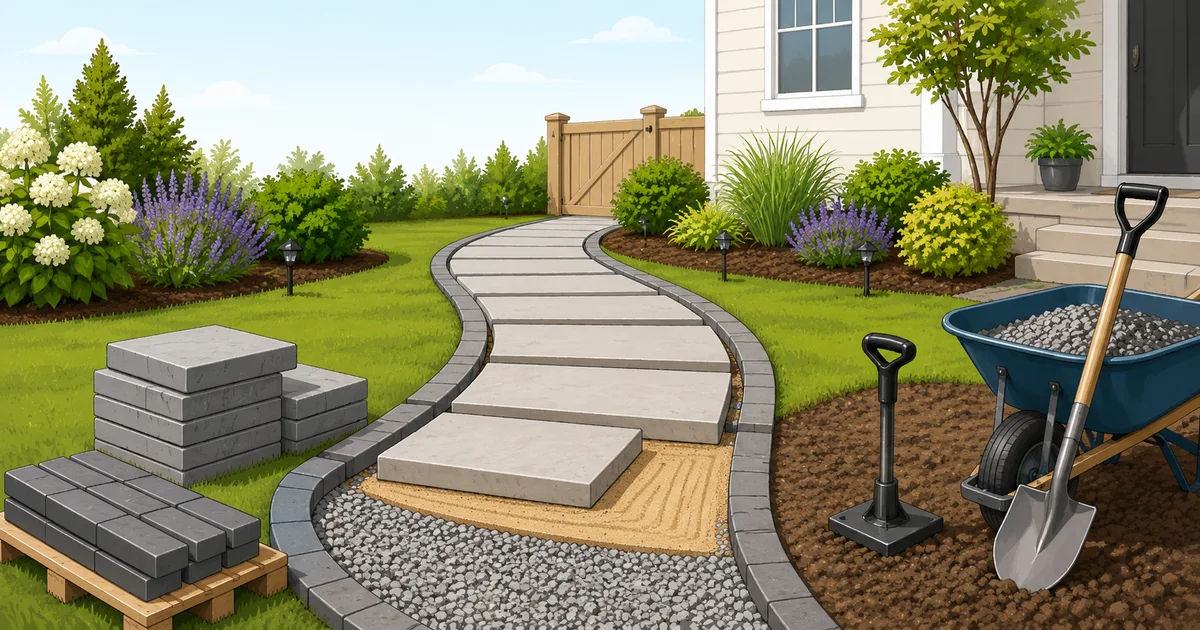
Walkway and Sidewalk Cost in 2026: Concrete, Pavers, Gravel and Stone Paths
A cost comparison and planning guide for residential walkways, sidewalks, and garden paths covering poured concrete, concrete pavers, gravel paths, flagstone, and stepping stones.
Quick Answer
Walkway and sidewalk costs range from $5 to $30 per square foot depending on material, width, base preparation, and labor. Gravel paths are the most economical at $5–$10 per sq ft, while natural flagstone is the most expensive at $20–$35 per sq ft. A standard 4 ft wide by 40 ft long walkway (160 sq ft) runs $800–$4,800 for materials, or $2,400–$5,600 professionally installed with concrete or pavers.
Quick Estimate
Cost ranges below are for a 160 sq ft (4 ft x 40 ft) standard residential walkway. Planning estimates based on 2026 US averages.
| Material | Material Cost per Sq Ft | Installed per Sq Ft | Lifespan |
|---|---|---|---|
| Poured concrete | $3–$6 | $8–$18 | 25–30 years |
| Concrete pavers | $4–$8 | $12–$22 | 20–40 years |
| Gravel / crushed stone | $1–$3 | $5–$10 | 3–5 years (refresh needed) |
| Flagstone (natural stone) | $8–$15 | $20–$35 | Lifetime+ |
| Stepping stones | $3–$8 | $8–$18 | 10–20 years |
| Brick pavers | $5–$10 | $15–$28 | 20–40 years |
Ranges are broad planning estimates. Actual costs depend on region, site access, base conditions, and material availability.
Planning estimate: All cost figures shown are broad 2026 US averages for planning purposes only. Material and labor costs vary significantly by region, site access, market conditions, and project specifications. Verify prices with local suppliers and contractors. This is not a quote, guarantee, or professional estimate.
Calculators Used in This Guide
Walkway Base Preparation: The Foundation Matters
Every walkway type requires some level of base preparation. The base depth and material depend on the walkway surface and local soil conditions. For concrete and paver walkways, expect 4–8 inches of compacted base material beneath the surface layer. Gravel and stepping stone paths require less depth but still benefit from a compacted sub-base and weed barrier fabric.
Standard walkway base layers include a 2–4 inch sub-base of crushed stone or recycled concrete aggregate, followed by a 1–2 inch leveling layer of finer gravel or sand. For paver walkways, a 1-inch bedding sand layer is placed on top of the compacted base before laying pavers. Concrete walkways require forms, reinforcement (wire mesh or rebar for heavy-use areas), and control joints to manage cracking.
Weed barrier fabric under gravel paths and between paver joints reduces long-term maintenance. Skip the fabric on concrete walkways — it serves no purpose under a solid slab. For natural flagstone, weed barrier between the stones is recommended unless you want moss or grass growing in the gaps intentionally.
Key Cost Factors for Walkway Projects
Several variables determine the final cost of a residential walkway. Material choice is the largest factor, but site conditions, walkway length and width, base requirements, and labor rates all play a role. A straight walkway on flat ground with good soil costs significantly less than a winding path on a slope requiring retaining walls or steps.
Site access matters more than most homeowners expect. If the walkway location is behind a fence, through a narrow gate, or on a slope that prevents concrete truck access, material delivery and labor costs increase. Hand-mixing concrete or carrying pavers and gravel by wheelbarrow adds time and labor expense. Expect a 10–25% premium for walkways with restricted access.
Walkway width directly scales material and labor costs. A 3 ft wide path uses 25% less material than a 4 ft wide path over the same length. However, narrow walkways reduce usability — a 36-inch path feels tight when two people walk side by side. For front walkways, 48 inches is the recommended minimum. For garden paths, 36 inches is adequate.
Curved walkways add 15–30% to installation cost compared to straight paths because every paver or stone at the edge must be cut individually. Concrete curves require custom bent forms, which add labor time. If budget is a primary concern, a straight walkway with a simple landing at each end provides the most value per dollar.
Poured Concrete Walkways
Poured concrete is the most common residential walkway material. A standard 4-inch thick slab with a broom finish costs $8–$18 per sq ft installed. Adding color (integral or surface stain), exposed aggregate, or stamped patterns raises the cost to $12–$25 per sq ft. Concrete walkways need control joints every 4–6 feet to manage cracking. A well-installed concrete walkway lasts 25–30 years with minimal maintenance.
For front walkways and curb ramps (ADA-compliant sidewalk transitions), many municipalities specify minimum width (typically 4 ft) and maximum cross-slope (2% or less). Check local requirements before pouring concrete near the street or sidewalk right-of-way. Use the Concrete Calculator to estimate how many cubic yards of concrete you need based on your walkway length, width, and slab thickness.
Concrete Paver Walkways
Paver walkways offer design flexibility and easier repairs than poured concrete. If a paver cracks or stains, you replace that single unit rather than cutting and patching a slab. Paver walkways also handle freeze-thaw cycles better than poured concrete in northern climates because the joints absorb movement.
The main disadvantage is the base preparation. Paver walkways need a full depth base of compacted aggregate (4–6 inches for pedestrian traffic) plus bedding sand. If the base settles, the pavers will shift, creating tripping hazards and water pooling areas. Use edge restraints on both sides of a paver walkway to prevent lateral movement.
Gravel and Crushed Stone Paths
Gravel paths are the most budget-friendly walkway option at $5–$10 per sq ft installed. Pea gravel, crushed granite, and decomposed granite are common choices. Gravel paths require edging (metal, plastic, or stone) to keep the material contained. Without edging, gravel spreads into adjacent lawn and garden beds over time.
The downside is maintenance. Gravel paths need annual topping-up as material migrates. They are also harder to shovel snow from and less comfortable for barefoot walking. For high-traffic front walkways, gravel is rarely the best choice — use it for garden paths and secondary routes instead.
Flagstone and Natural Stone Walkways
Flagstone walkways are the premium option in terms of appearance and longevity. Natural stone can last indefinitely if installed on a proper base. The irregular shapes and natural color variations create a high-end look that increases property value. The tradeoff is cost: flagstone materials alone run $8–$15 per sq ft, and professional installation brings the total to $20–$35 per sq ft.
Flagstone can be laid on a sand base (dry-laid) or a concrete mortar base (wet-laid). Dry-laid flagstone is more DIY-friendly and allows easier repairs. Wet-laid flagstone is more stable but requires masonry skills and is harder to modify later. Joints between stones can be filled with polymeric sand, gravel, or planted with creeping ground cover.
Stepping Stone Paths
Stepping stone paths use individual stones placed at natural walking intervals (typically 18–24 inches on center). This style creates an informal, meandering path ideal for garden beds, side yards, or lawn crossings. Stepping stones cost $8–$18 per sq ft installed, depending on stone type and spacing.
The key measurement for stepping stone paths is the stride distance. If stones are too far apart, walkers will step on the grass or gravel between them, defeating the purpose. Place stones so the center-to-center distance matches a comfortable natural stride for the average adult — roughly 24 inches.
Worked Example: 4 ft x 40 ft Concrete Paver Walkway
The following example walks through a typical front walkway installation using concrete pavers. This is a common project size for a single-family home — 4 ft wide by 40 ft long, covering 160 sq ft. Prices reflect 2026 US planning averages and will vary by region and season.
| Item | Quantity | Unit Cost | Total |
|---|---|---|---|
| Concrete pavers (60 mm, 4x8 size) | 720 pavers | $0.70/paver | $504 |
| Crushed stone base (4 inches) | 2 cu yds | $40/cu yd | $80 |
| Bedding sand (1 inch) | 0.5 cu yds | $35/cu yd | $18 |
| Edge restraints (plastic with spikes) | 80 linear ft | $2/ft | $160 |
| Polymeric joint sand | 2 bags | $25/bag | $50 |
| Weed barrier fabric | 160 sq ft | $0.15/sq ft | $24 |
| Total materials (DIY) | $836 | ||
| Professional labor (average) | 2 days | $600/day | $1,200 |
| Total professional install | $2,036 | ||
This $836 DIY estimate covers materials only. Adding professional labor at $600 per day for a 2-person crew brings the installed total to roughly $2,036, or about $12.70 per sq ft — consistent with the lower end of the paver walkway range. Using flagstone instead of concrete pavers would roughly double the material cost. Using poured concrete instead would reduce material cost to about $480 for a 4-inch slab but require professional finishing skills.
To estimate quantities for your specific walkway dimensions, use the Paver Calculator for paver count and the Square Footage Calculator to confirm your total area. The Gravel Calculator helps with base aggregate volume, and the Sand Calculator covers bedding sand needs.
Accessibility and Slope Requirements
Walkways connecting to public sidewalks or serving as primary home entrances should meet basic accessibility standards. A minimum width of 48 inches is recommended for wheelchair and stroller passage. The cross-slope (side-to-side) should not exceed 2% (1/4 inch per foot) for comfortable walking and ADA compliance where applicable. The running slope (along the walkway) should not exceed 5% without including level landings.
If your property has a slope from the street to the front door, consider a switchback walkway design or terraced steps with landings rather than a single steep ramp. Steep walkways are hazardous when wet or icy and can create drainage issues where the path meets the house foundation. For properties with significant grade changes, a retaining wall along the walkway edge may be needed, adding $2,500–$8,000 to the project. See the retaining wall guide for cost details.
Drainage is equally important. The walkway surface should direct water away from the house foundation and toward adjacent landscape beds or a drainage swale. A crown (slightly higher center) on concrete walkways or a consistent 1–2% cross-slope on paver walkways prevents water from pooling against the house. In areas with heavy clay soil, a French drain along the uphill side of the walkway may be necessary.
Walkway Width Standards
Walkway width affects both cost and usability. A minimum width of 36 inches is recommended for single-person passage. For two people walking side by side, plan for 48–60 inches. Front walkways should be at least 48 inches wide to accommodate moving furniture, trash bins, or wheeled items. Wider walkways cost proportionally more because every additional inch of width increases material and labor linearly.
Permits and Property Line Considerations
Work near the street or sidewalk right-of-way may require a permit from your municipality. Setback requirements, curb ramp specifications, and drainage rules vary by jurisdiction. Some cities require engineered sidewalk plans for walkways that cross the public right-of-way. Check with your local planning department before starting construction.
For walkways near property lines, verify that the path sits entirely within your property. Building a walkway over a property line (even unintentionally) can create easement or encroachment issues that complicate future property sales.
DIY vs Professional Walkway Installation
Gravel and stepping stone paths are the most DIY-friendly walkway options. Both require basic excavation, compaction, and leveling skills that most homeowners can manage over a weekend. Paver and concrete walkways are more demanding — forming concrete requires experience with screeding, finishing, and joint cutting, and mistakes in the pour cannot be undone. Paver walkways require precise grading and compaction to avoid future settling, but the modular nature allows correction if the base is done correctly.
For long walkways (over 60 ft), poured concrete should be installed by a professional who can manage expansion joints, reinforcement, and proper curing. Professional labor for concrete walkways runs $5–$12 per sq ft. Paver installation labor adds $8–$14 per sq ft. A hybrid approach works well for many homeowners: hire a pro for concrete work and DIY the paver or gravel sections where the risk is lower.
Common Walkway Mistakes to Avoid
Skipping the base compaction. Even a thin paver or stepping stone path needs a compacted base. Loose soil under the walkway settles over time, creating uneven surfaces and tripping hazards. Compact the base in 2–3 inch lifts with a plate compactor. For short gravel paths, hand tamping is acceptable but less reliable.
Wrong walkway width. A 24-inch wide path feels narrow for two people walking together and makes carrying furniture, trash bins, or garden equipment difficult. For front walkways, 48 inches is the practical minimum. For garden paths, 36 inches allows comfortable single passage with room for plants to overhang.
Poor drainage slope. Walkways that are flat or slope toward the house create ponding water, ice hazards in winter, and potential foundation moisture issues. Always slope the walkway surface away from the house at a minimum of 1/4 inch per foot. For walkways on flat lots, a crowned surface that sheds water to both sides is an effective solution.
No weed barrier under gravel. Gravel paths installed without weed barrier fabric become weed nurseries within one season. The fabric blocks sunlight and prevents weed seeds in the soil below from germinating. Use landscape fabric rated for 5+ years UV resistance and cover it completely with at least 3 inches of gravel.
Concrete poured too thin. A 2-inch thick concrete walkway will crack under normal foot traffic within a year. Residential walkways need a minimum 4-inch slab thickness. For walkways that will support vehicle traffic (driveway approach or curb cut), increase to 6 inches with reinforcement.
Forgetting the edge restraint on paver paths. Pavers and gravel both need edge restraints to maintain their shape. Without them, paver edges shift outward over time and gravel migrates into adjacent lawn or garden beds. Use metal or plastic edging for straight sections and flexible edging for curves.
Frequently Asked Questions
Related Calculators
References and Data Sources
National Concrete Masonry Association — Residential Walkway Design Guide
Design specifications and best practices for concrete and paver residential walkways, including base preparation and joint spacing standards.
Americans with Disabilities Act (ADA) — Sidewalk and Curb Ramp Standards
Federal accessibility standards for walkway width, slope, cross-slope, and curb ramp design applicable to public right-of-way walkways.
American Society of Landscape Architects — Residential Path and Walkway Materials
Material selection guidance for residential walkways, including cost comparisons and lifecycle analysis for common paving materials.
All references are used for general estimation guidance only. BuildCalcHub does not claim certification, endorsement, or partnership with any listed organization. Always consult a licensed professional for your specific project requirements.
Cost Guides
Explore more project cost guides